Table of Contents
ToggleLED under cabinet strip lighting has transformed how homeowners approach kitchen functionality and ambiance. No longer reserved for high-end renovations, affordable LED strips now make it possible to add task lighting directly where you need it, without rewiring your entire kitchen. Whether you’re looking to brighten your countertop workspace, create warm ambient lighting for entertaining, or add a touch of modern style to dated cabinetry, LED strips offer flexibility that older fluorescent tubes and halogens simply can’t match. This guide walks you through everything you need to know to choose, install, and get the most out of LED under cabinet lighting.
Key Takeaways
- LED under cabinet strip lighting eliminates shadows on countertops and provides focused task lighting for food prep, making kitchens safer and more functional without requiring rewiring.
- Plug-in LED strip systems offer affordable, renter-friendly installation ($50–200) that takes just a weekend, while hardwired systems provide a cleaner look but require an electrician ($300–800 labor).
- Choose warm white (2700K) for ambiance or neutral white (3500–4000K) for accurate food prep, and prioritize strips with CRI 90+ and 10–20 foot-candles of brightness for optimal task lighting.
- LED strips are 3–8 times more energy-efficient than fluorescent fixtures and last 25,000–50,000 hours, reducing replacement costs and electric bills over 5–10+ years of use.
- Proper surface preparation, accurate measurements, and pre-installation testing prevent common issues like sagging strips and inadequate brightness, ensuring long-term performance and satisfaction.
What Is LED Under Cabinet Strip Lighting and Why It Matters
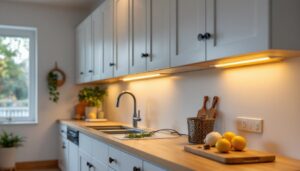
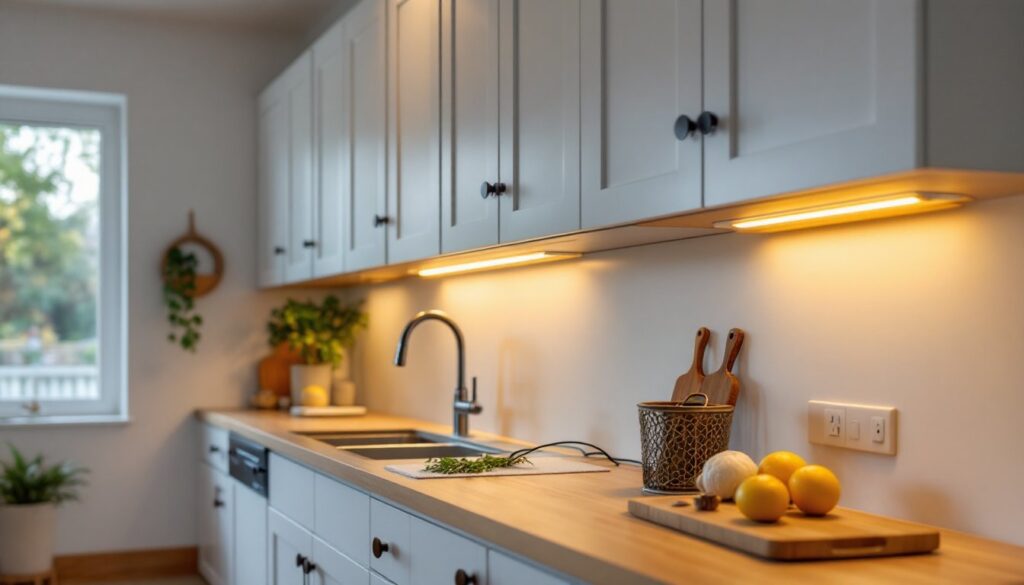
LED under cabinet strip lighting refers to flexible or rigid light fixtures installed on the underside of kitchen cabinets, shining downward onto countertops. These strips are typically 5–10mm wide and come in various lengths, usually sold in 16-foot rolls that you cut to size. The lights sit in shallow aluminum channels (extrusions) that protect the LED tape and help dissipate heat.
Why it matters: Task lighting in kitchens is essential. General ceiling fixtures cast shadows on your countertop workspace, making food prep and cooking harder on your eyes and more accident-prone. LED strips eliminate that shadow zone and provide focused, even illumination exactly where you work. Beyond function, they’re also stylish, warm white or tunable white options create inviting atmosphere, while RGB strips let you adjust color for entertaining or task work. Unlike older fluorescent or halogen under-cabinet lights, LEDs run cool, use minimal electricity, and last 25,000+ hours, meaning you’re not replacing them every few years.
Key Benefits of Installing LED Strip Lights Under Cabinets
Improved Task Lighting: LED strips eliminate shadows on your countertop and make food prep, reading recipes, and cleanup easier. Many homeowners find they actually use their counters more effectively once proper task lighting is in place.
Energy Efficiency: LED strips draw between 3–8 watts per running foot (depending on brightness and color options), compared to 15–25 watts for older fluorescent under-cabinet fixtures. Over a year, that’s a noticeable difference on your electric bill.
Long Lifespan: Quality LED strips rated for 25,000–50,000 hours mean you’re installing them once and forgetting about them for 5–10+ years of typical use. No burnt-out tubes to replace quarterly.
Design Flexibility: Unlike fixed puck lights or bulky fluorescent bars, LED strips bend and conform to cabinet edges. You can run them the full length of your cabinet run or highlight specific zones. Color temperature options (warm 2700K, neutral 4000K, or cool 5000K) let you match your kitchen’s mood.
Retrofit-Friendly: Most plug-in LED strip systems require no electrician and no permits. If you have existing hardwired under-cabinet lights, you can usually replace them: if you don’t, a plug-in option installs in an afternoon without running new circuits.
Dimmable Options: Many modern LED strips pair with wireless remotes or smart home systems, letting you adjust brightness throughout the day or season.
Types of LED Under Cabinet Lighting Systems
Hardwired vs. Plug-In Options
Hardwired LED Systems are integrated directly into your kitchen’s electrical circuit. An electrician runs a 14-gauge or 12-gauge cable from your breaker panel (or a nearby switch) to the under-cabinet location, then connects the LED strips via a driver (power converter). Hardwired setups are ideal if you already have wiring behind or beneath your cabinets, want a clean appearance with zero visible cords, or plan to install dimmer switches integrated with the rest of your kitchen lighting. The downside: installation requires an electrician and, depending on your jurisdiction, may need a permit if you’re adding a new circuit. Expect $300–800 in labor alone.
Plug-In LED Systems connect to a standard 120V outlet via a power supply and control unit. The strips themselves plug into a connector block, no hardwiring needed. Installation is a weekend DIY project: measure, cut the adhesive-backed tape, stick it to the cabinet underside, and plug in. Plug-in systems are budget-friendly ($50–200), require no permits, and are renter-friendly. The trade-off: you see the power cord running to an outlet, and you’re limited by outlet location. But, many modern plug-in kits come with wireless remotes and smart-home compatibility, so you don’t lose control features.
Hardwired with Smart Control: Some systems combine hardwired installation with a smart driver, letting you use Alexa, Google Home, or phone apps to control brightness and color without adding any visible control hardware.
Puck Lights vs. Strip Lights: Puck lights are small, round individual fixtures spaced along the cabinet bottom. Strips are continuous or segmented tape. Strips cast more even light with fewer dark spots: puck lights are modular and easier to replace individually but create visible gaps unless densely spaced.
How to Choose the Right LED Strips for Your Kitchen
Color Temperature: Warm white (2700K) matches traditional incandescent bulbs and creates a cozy, inviting feel, ideal for eating areas and entertaining. Neutral white (3500–4000K) is crisp and professional, best for cooking and prep zones where you want accurate color rendering (especially helpful when checking meat doneness or vegetable ripeness). Cool white (5000K) is sterile but bright: it’s less common for kitchens. Tunable white systems let you adjust between warm and neutral depending on time of day or activity.
Brightness (Lumens per Watt): Look for strips rated 80–100 lumens per watt minimum. A rule of thumb: under-cabinet lighting should deliver 10–20 foot-candles at the counter surface. For a typical 30-inch deep countertop, a 12-watt continuous strip running the full length of a 4-foot cabinet run usually suffices. If your cabinets are deep or you want very bright task lighting, go higher.
CRI (Color Rendering Index): CRI measures how accurately colors appear under the light. For kitchen task lighting, aim for CRI 90+. This ensures vegetables look vibrant, meat color is accurate, and you’re not working under artificial-looking light.
Dimmable or Non-Dimmable: Dimmable strips cost more but offer flexibility, brighter for cooking, softer for ambiance. Most modern plug-in systems include wireless dimmers: hardwired systems require a compatible dimmer switch in your wall.
IP Rating: Under-cabinet locations aren’t typically wet, but kitchens have steam and humidity. Look for IP65 or higher if your strips will be near the sink or stove: IP44 is acceptable for general countertop areas.
Length and Modularity: Most strips are sold in 16-foot rolls (cuttable every 2–3 inches). Measure your cabinet run beforehand. If you need less than 16 feet, buy the full roll and save the excess: if you need more, you can connect multiple segments of under-cabinet lighting using extension cables or connector blocks.
Budget: Affordable plug-in kits run $50–150: mid-range hardwired systems with smart controls, $400–800: premium hardwired setups with integrated dimming and color tuning, $1,000+. Value isn’t always in the price tag, a $100 plug-in kit with good CRI and warm color temp may outperform a $300 system with poor light quality.
Installation Tips for DIY Success
Prepare and Measure: Start by cleaning the underside of your cabinet with a degreaser or rubbing alcohol. LED tape is adhesive-backed, and dust or residue will weaken the bond and cause sagging over months. Measure the length of each cabinet run, accounting for corners (you can bend rigid aluminum channels gently, or use corner brackets for 90-degree turns). Measure once, cut once, mark your cut lines with tape.
Mounting Options: Adhesive backing works for most cabinets, but if you want to avoid permanent adhesion or your cabinet finish is glossy, use mounting clips ($10–20 for a set). Clips screw into the cabinet underside and hold the aluminum extrusion securely. For added insurance on longer runs (8+ feet), use clips every 12–16 inches to prevent sagging.
Wiring and Power: For plug-in systems, run the power cable along the back edge of the cabinet toward your nearest outlet, securing it with adhesive clips. Keep the cable out of sight if possible, behind a cove or along the cabinet side. For hardwired systems, have your electrician run the cable and control unit before you install the strips. Always install a dedicated 15-amp circuit if adding multiple strip sections: a single outlet won’t safely support high-brightness strips across an entire kitchen.
Cutting and Connecting: LED tape is cuttable at marked intervals (usually every 2–3 inches). Use a sharp utility knife: a clean cut is crucial for soldering or connecting clips. If you’re avoiding solder, use solderless connectors (splice blocks), push the stripped wire ends into the connector blocks and tighten the set screws. They cost more ($2–5 each) but are beginner-friendly.
Testing Before Final Installation: Before securing the strips permanently, plug them in and test brightness, color, and any remote controls. Adjust positioning if needed, you want light angled downward at the counter, not spilling up into cabinets or creating glare.
PPE and Safety: Wear eye protection when drilling or routing cable. If your cabinet interior has any asbestos-containing material (rare in kitchens built after the 1980s, but possible), don’t disturb it, consult a professional. LED strips themselves generate minimal heat, but don’t bundle cable or wrap strips tightly around tight corners where heat can’t escape.
Common Mistakes: Not cleaning the surface before adhesion (strips fall within weeks). Underestimating brightness and installing weak 3–5 watt strips when 12+ watts is needed. Running power cables where they’ll be pinched by opening cabinet doors. Forgetting to account for the thickness of the aluminum extrusion when measuring countertop clearance, the channel typically adds 0.5–1 inch below the cabinet edge.
Conclusion
LED under cabinet strip lighting is one of the highest-ROI kitchen upgrades a DIYer can tackle. It’s affordable, installs in a weekend, and transforms how your kitchen functions and looks. Whether you choose a simple plug-in kit or invest in hardwired smart lighting, focus on color temperature (warm or neutral for kitchens), brightness (10–20 foot-candles), and CRI (90+) to get genuine task lighting, not just decorative glow. Start with accurate measurements, prep your surfaces properly, and don’t skip the testing phase. Homeowners exploring comprehensive under-cabinet lighting solutions often find that a combination of task strips near prep zones and ambient strips elsewhere strikes the best balance. Your kitchen will be brighter, more functional, and ready for years of cooking ahead.