Table of Contents
ToggleGood kitchen lighting isn’t a luxury, it’s the foundation of a functional, inviting space. Contemporary kitchen lighting has evolved far beyond the standard flush-mount ceiling fixture. Today’s homeowners expect fixtures that blend seamlessly into modern design while delivering the right light for cooking, dining, and gathering. Whether you’re remodeling your kitchen or just updating an outdated fixture, understanding the principles of contemporary lighting design will help you make choices that genuinely improve how your space feels and functions. This guide walks through the essentials: why it matters, what layering means, which fixtures work best, and how to install them without calling in the pros every time.
Key Takeaways
- Contemporary kitchen lighting relies on three-layer design—ambient, task, and accent light—to create a functional and inviting space that serves cooking, dining, and entertaining needs.
- Task lighting under cabinets and over work areas should deliver 75–100 foot-candles with 4000K neutral white LEDs to prevent eye strain and shadows while prepping food.
- Popular contemporary fixtures like pendant lights, track systems, and recessed LEDs offer modern aesthetics while being energy-efficient and lasting 25,000+ hours, cutting electricity costs compared to older incandescent setups.
- Proper pendant installation requires measuring 30–36 inches above countertops and island surfaces to avoid glare and head bumps while maintaining both visual balance and functional lighting.
- Before installing contemporary kitchen lighting, verify your existing electrical wiring is 20-amp, 12-gauge, and always use a voltage tester and respect National Electrical Code safety standards to prevent electrical hazards.
- Choose fixture finishes—brushed brass, matte black, or stainless steel—that coordinate with your cabinetry and hardware to create visual cohesion throughout your kitchen design.
Why Contemporary Kitchen Lighting Matters
Your kitchen isn’t just a cooking zone anymore, it’s a workspace, a dining room, and often the heart of your home. Poor lighting turns a beautiful kitchen into a frustrating one: shadows over the countertop where you’re chopping vegetables, glare bouncing off stainless steel, or an overhead light so harsh it feels clinical.
Contemporary lighting design solves these problems by creating zones. Task lighting keeps you safe and precise when you’re working. Ambient light sets the mood when you’re entertaining or eating breakfast. Accent lighting highlights design features or your backsplash.
Beyond function, contemporary fixtures are built to last visually. Unlike dated recessed cans or dusty track systems from the 1990s, modern pendant lights, linear fixtures, and integrated LEDs age gracefully and adapt to evolving design trends. They’re also more energy-efficient than older incandescent or fluorescent setups, cutting your monthly electric bill while reducing heat output in an already-warm kitchen.
Investing time in thoughtful lighting design pays off every single day you use your kitchen.
Essential Elements of Modern Kitchen Lighting Design
Layering Light for Function and Ambiance
Layered lighting is the core principle behind any professional-looking kitchen. Think of it as three distinct roles working together rather than one fixture doing everything poorly.
Ambient lighting is your baseline, the general light that lets you see across the whole kitchen without shadows or dark corners. A single ceiling fixture rarely cuts it: modern kitchens use a combination of recessed lights, a central pendant over an island, or a linear LED fixture running the length of the room. Aim for 30–50 foot-candles of ambient light in your kitchen (a foot-candle is roughly the light from a single candle one foot away). Most contemporary kitchens achieve this with 4–6 recessed 3-inch or 4-inch fixtures spaced 4–6 feet apart, depending on ceiling height and fixture brightness (measured in lumens).
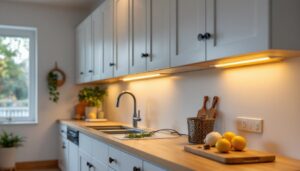
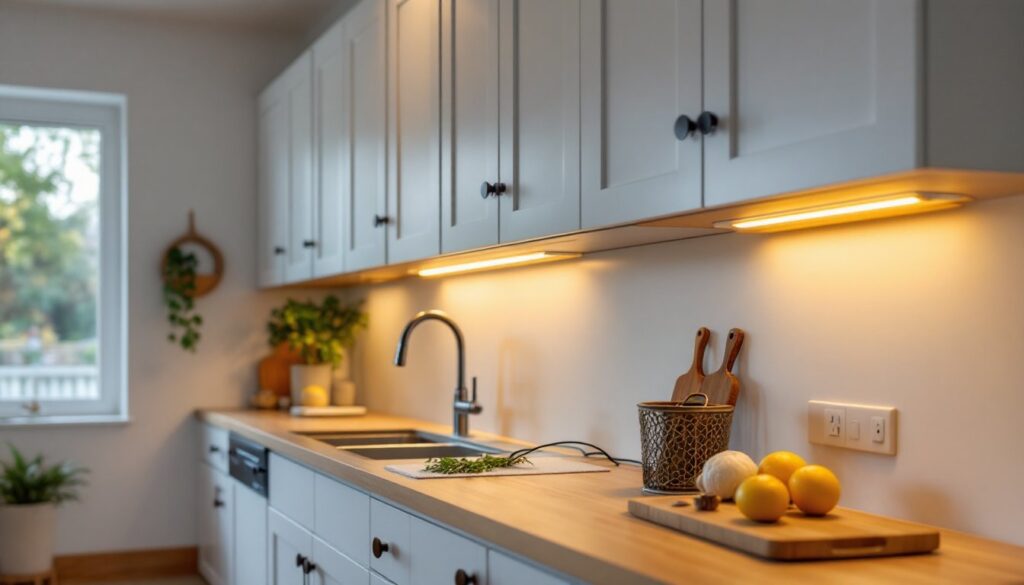
Task lighting focuses bright, shadow-free light directly onto work surfaces. Under-cabinet LED strips, pendant lights hung 30–36 inches above a countertop or island, and track lights all qualify. Task areas need 75–100 foot-candles to prevent eye strain and shadows. This is where you see the biggest gap in DIY kitchens: many homeowners skip under-cabinet lighting, then spend years squinting while they prep food. A run of LED strip lights with a color temperature of 4000K (neutral white) is ideal for task lighting: it mimics daylight without the warmth of older incandescent bulbs that made colors look muddy.
Accent lighting is the cherry on top. It’s decorative but purposeful, spotlighting open shelving, highlighting artwork, or illuminating your backsplash. Accent lights use less power and typically run at 10–20 foot-candles. This is where personality enters the design: you might use a dimmable pendant in brushed brass, a linear track system in matte black, or rope lighting hidden above crown molding.
Dimmers are critical to pulling this off. Even the best-designed layered system feels awkward if every light is locked at full brightness. Contemporary kitchens use smart dimmers or traditional ELV (electronic low-voltage) dimmers compatible with LED bulbs. Check your specific fixture wattage and dimmer rating before buying, not all dimmers work with all LEDs, and mismatched equipment causes flickering or won’t work at all.
Popular Contemporary Lighting Fixtures for Kitchens
Pendant Lights, Track Systems, and Recessed Options
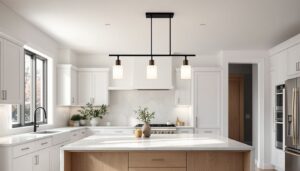
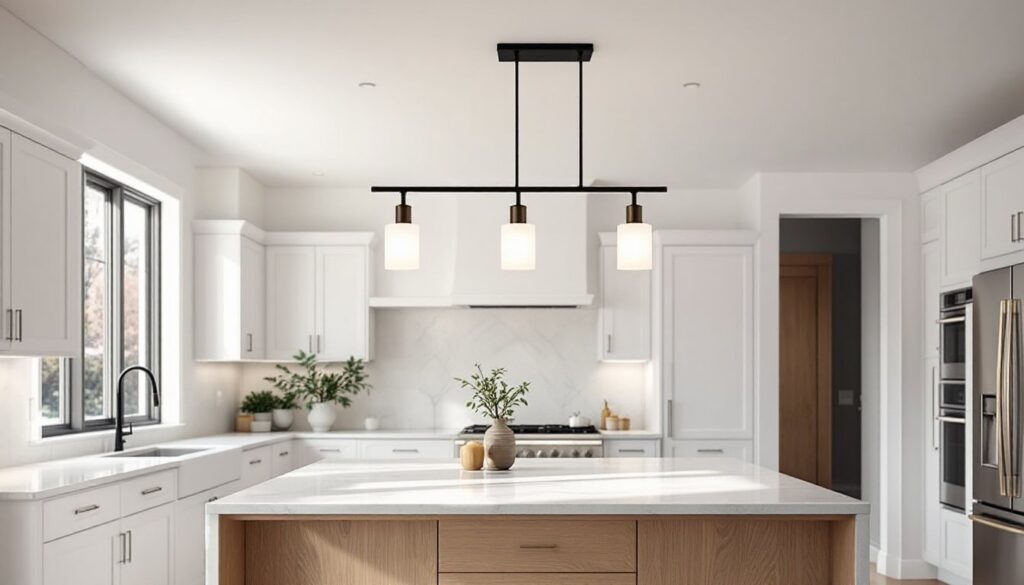
Pendant lights are the showstopper in modern kitchens. Hung 12–18 inches above an island or peninsula (or 30–36 inches above a dining table), they provide both task and ambient light while serving as a design focal point. Contemporary pendants come in virtually every finish, matte black, brushed gold, white, or powder-coated steel, and materials like metal, glass, or ceramics. When installing pendants, measure from the countertop surface to the bottom of the fixture: you want enough clearance that someone standing at the counter won’t bump their head, but low enough to avoid glare in people’s eyes sitting at the island. A cluster of three 10-inch pendants spaced evenly above a 10–12 foot island looks proportional: two larger pendants work for shorter islands. Most contemporary pendant fixtures arrive with a ceiling canopy, adjustable cord or rod, and wiring pre-connected: if you’re comfortable turning off the breaker and wiring a basic fixture, installation is straightforward.
Track lighting is underrated in contemporary kitchens. Unlike the thin, silvery track systems from the 1990s, modern track comes in sleek profiles, black, white, or hidden in architectural molding, with fixtures that blend in rather than dominate. Track systems let you adjust individual spotlights or flood lights without running new wiring: you snap fixtures into the track and rotate them where you need light. A 6–8 foot linear track with adjustable spotlights works well over a long countertop or galley wall. Dimmable LED track heads draw minimal power (5–12 watts per bulb vs. 50+ for old halogen) and don’t generate heat, critical in a kitchen where you’re already managing oven warmth.
Recessed lighting, when done right, is the workhorse of contemporary kitchens. Modern recessed fixtures are slim (some only 2 inches deep), install into standard 16-inch joist spacing, and come with 3-inch, 4-inch, or 5-inch trim rings in various finishes. The key to not looking dated is spacing and type: avoid a haphazard grid and instead cluster recessed lights where you need them (over the sink, stove, and main work zones) while leaving darker zones for drama. LED recessed fixtures run 7–12 watts per bulb and last 25,000+ hours: buying quality fixtures upfront costs more but saves on replacement bulbs and energy bills. A standard IC-rated recessed fixture (insulation contact, safe to touch insulation) is essential if you have attic space above: non-IC fixtures run hot and are a fire hazard if insulation touches the housing.
Linear fixtures, long, thin bars of light, are huge in 2026 contemporary design. You’ll see them built into soffits above cabinets, mounted under upper cabinets for task lighting, or hung as statement pieces. These integrate beautifully into minimalist kitchens and hide the bulbs, so there’s no glare. Most are LED-only and don’t take traditional bulbs: they’re hardwired to a dimmer, giving them a sleek, finished appearance.
Practical Installation and Material Choices
Before buying a single fixture, know what’s already in your walls. Turn off the breaker to your kitchen and inspect your existing setup. Are you working with 14-gauge or 12-gauge electrical wire? (Kitchen circuits should be 20-amp, 12-gauge: older homes sometimes have undersized wiring.) Can you reuse existing junction boxes, or will you need to run new circuits? If you’re adding significant load, say, converting two old incandescent fixtures to new LED pendant lights plus track, you’re probably fine on the same circuit, but if you’re running new runs or powering a major install, consult a licensed electrician. Kitchen lighting is covered under the National Electrical Code (NEC): while aesthetic choices are yours, electrical safety is not negotiable.
Fixture materials and finishes in contemporary kitchens should complement your cabinetry and countertops. Brushed brass pairs beautifully with warm wood or white cabinets. Matte black works with everything and hides dust better than polished finishes. Stainless steel echoes appliances. Glass or frosted acrylic diffusers soften harsh LED light better than bare bulbs. When choosing pendant finishes, pick materials that echo elsewhere in your kitchen, a brushed brass pendant should match your faucet or cabinet hardware, creating visual cohesion.
Under-cabinet LED strips need a substrate to mount on. If you have a solid soffit or cabinet overhang, adhesive-backed strips work fine: if the surface is textured or has a finish that won’t hold tape permanently, use aluminum channels with small screws (pre-drill to avoid splitting wood). Run the strip 2–3 inches in from the cabinet edge: this hides the emitter from eye level while still lighting the counter below. Most LED strips plug into a controller box that connects to a dimmer switch: plan wire runs during rough-in, not as an afterthought.
Recessed fixture installation requires cutting drywall holes and working above the ceiling (if the kitchen is on the upper floor, you’ll need attic access). A standard 4-inch trim ring requires a 4-5/8-inch hole: use a drywall hole saw on a drill. Run electrical wire from the junction box to each fixture location, connect house power to a dimmer switch, then wire each recessed can in parallel (not series, series wiring means one failed bulb kills the whole string). If attic space is inaccessible, talk to a contractor: retrofitting recessed lights without attic access is labor-intensive and may require ceiling removal.
Material and finish durability: Kitchen lighting takes abuse, grease, steam, humidity. Choose fixture materials resistant to corrosion: stainless steel, powder-coated aluminum, or sealed brass. Avoid bare steel or untreated metal if your kitchen has high humidity. LED bulbs themselves are robust (they don’t burn out like incandescent bulbs), but cheap fixtures with poor heat dissipation fail faster. A dimmable LED bulb rated for enclosed fixtures costs 30–50% more than basic LEDs but won’t overheat or flicker in recessed cans or pendant shades.
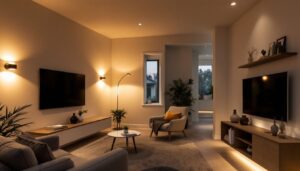
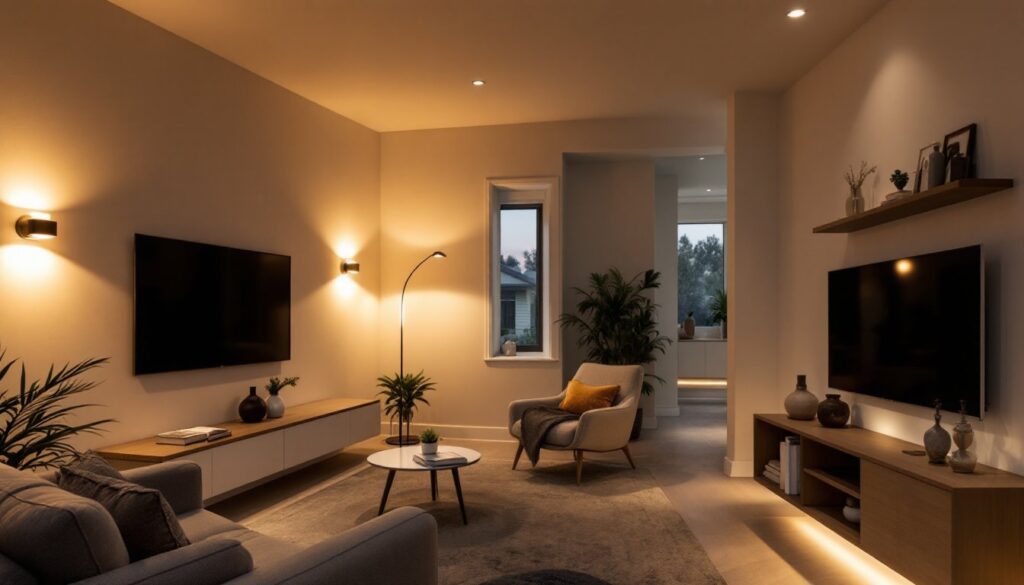
When pendant lights suited to kitchen islands appeal to you, sketch your layout first. Sketch your island dimensions, mark pendant locations (evenly spaced, centered), measure your countertop-to-ceiling height, and note any overhead obstacles (beams, ducts, exhaust hoods). This 30-minute sketch prevents mistakes that cost you a second trip to the fixture store. Design-forward fixture options showcase contemporary styles, and pairing them with living room lighting principles helps you understand how layering works room-to-room. If you’re overhauling your entire home’s lighting, check resources like The Kitchn for integrated design thinking.
Safety and PPE: When working above the ceiling, wear safety glasses and a dust mask: attic insulation sheds fibers. If you’re drilling into drywall or wood, safety goggles protect your eyes from debris. Use a voltage tester before touching any wire, once. A $10 non-contact voltage tester catches live wires instantly and prevents shocks or electrocution. Never assume a breaker is off: test the circuit first.
Conclusion
Contemporary kitchen lighting transforms your space by balancing function with aesthetics. Layer your light, ambient, task, and accent, install fixtures that age gracefully, and match materials to your design. Start with a rough sketch, respect electrical codes, test your circuits, and don’t skip under-cabinet task lighting. Your future self will thank you every time you’re chopping vegetables with clear, shadow-free vision or settling in to dinner under a beautiful, dimmable pendant.