Table of Contents
ToggleUnder cabinet lighting with plug options has transformed how homeowners illuminate their kitchens without calling an electrician or running wires behind walls. Unlike hardwired systems, plug-in under cabinet lights connect to standard outlets and offer instant, professional-looking results. Whether you’re upgrading a dated kitchen or adding task lighting to a newly renovated space, plug-in solutions deliver flexibility, affordability, and real functional benefits. This guide walks you through choosing the right system, understanding your options, and installing them correctly so your kitchen workspace becomes both more functional and visually appealing.
Key Takeaways
- Under cabinet lighting with plug eliminates the need for electrical work, permits, or licensed contractors, making it an ideal DIY solution for homeowners of all experience levels.
- LED strip lights and puck lights are the two main options: strips offer affordable, even illumination at $20–$60 per run, while puck lights and track systems ($50–$150) provide focused lighting and repositioning flexibility.
- Proper surface preparation—cleaning with a degreaser before installation—is critical to preventing plug-in light strips from peeling away within months.
- Choose warm white (2700K) for a residential feel or neutral white (4000K) for modern task lighting, aiming for 50–100 lumens per linear foot to balance functionality with ambiance.
- Efficient cord management using cable raceways, clips, or outlet placement behind appliances keeps your under cabinet lighting installation looking polished and professional.
- Modern LED under cabinet lights use 75–80% less electricity than older incandescent options and last 25,000+ hours, delivering long-term energy savings with minimal maintenance.
Why Under Cabinet Lighting With Plug Is Perfect for DIY Homeowners
Plug-in under cabinet lighting eliminates the biggest barrier to DIY kitchen upgrades: electrical work. You’re not dealing with junction boxes, circuit breakers, or the need for a licensed electrician. Unpack the fixture, plug it in, and you’ve got functional lighting in minutes. This approach also gives you the freedom to adjust, relocate, or swap out fixtures without permanent installation headaches.
Another advantage is reversibility. If you’re renting or hesitant about permanent changes, plug-in systems are friendly to both situations. They’re equally popular with homeowners doing quick refreshes and those planning long-term renovations. The technology has matured too, modern LED plug-in systems consume minimal electricity, run cool, and last for years.
Top Benefits of Plug-In Under Cabinet Lights
- No electrical work required: Standard outlet connection: no permits or licensed contractors needed for most installations.
- Instant installation: Most systems mount with adhesive strips, small brackets, or simple hardware, typically 30 minutes or less per run.
- Energy efficient: LED options use 75–80% less electricity than incandescent equivalents and run for 25,000+ hours.
- Adjustable brightness: Many plug-in models include dimmer switches or app controls for fine-tuned ambiance and task lighting.
- Reversible: Adhesive-backed strips peel away cleanly: bracket-mounted units unscrew without damage to cabinets or countertops.
- Cost-effective upgrade: Lower upfront material and labor costs compared to hardwired systems, with professional visual impact.
Types of Under Cabinet Lighting With Plug
Plug-in under cabinet lights fall into two main categories, each with trade-offs in brightness, flexibility, and aesthetics.
LED Strip Lights
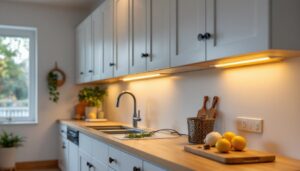
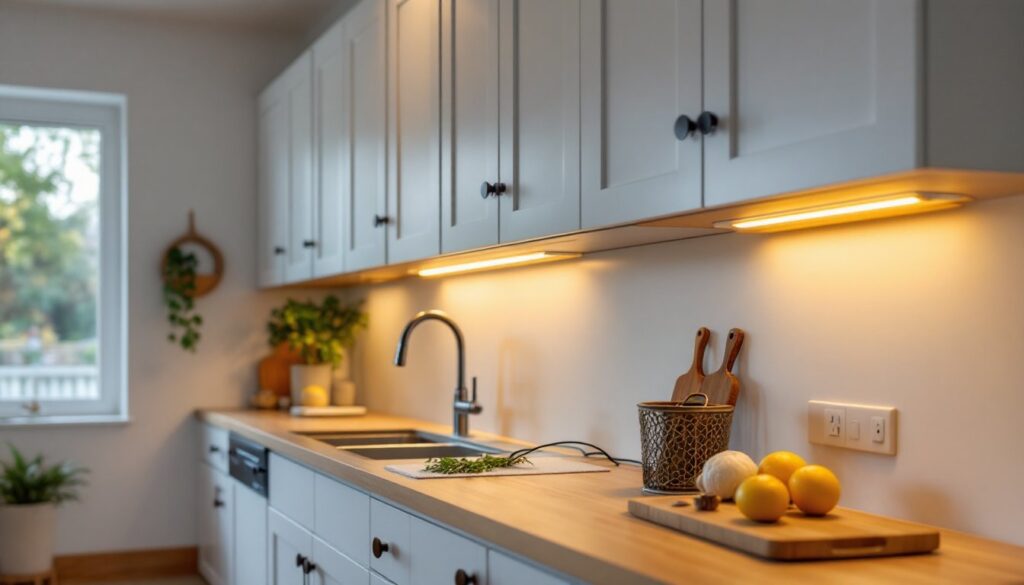
LED strip lights come in rolls or pre-cut segments and adhere directly to the underside of cabinets. They’re flat, discreet, and available in various color temperatures (warm white, neutral white, cool white) and even color-changing RGB options for accent lighting.
Strip lights excel at even, distributed illumination across a long run. They’re also the most affordable option, expect $20–$60 for basic warm-white strips covering a standard 8–10 foot run. The downside is limited adjustability: once stuck down, repositioning leaves adhesive residue. Look for strips with 3M VHB adhesive or similar heavy-duty backing: cheaper options peel away within months, especially in warm kitchens with steam and moisture.
Installation is straightforward: clean the cabinet underside with a degreaser (any soap residue or dust prevents adhesion), peel the backing, and press firmly for 30 seconds. If your cabinets have a curved edge or decorative trim, strips may not sit flush: in those cases, puck lights or track systems work better.
Puck Lights and Track Systems
Puck lights are small, cylindrical fixtures (typically 2–3 inches wide) that mount individually under cabinets using brackets or adhesive. They’re ideal for spotlighting specific areas, over the stove, sink, or prep counter, and offer more focused, dramatic lighting than strips.
Track systems mount a rail along the cabinet edge and let you position individual fixtures anywhere along that rail. This flexibility is invaluable if you’re not sure about final placement or want to adjust lighting as your kitchen evolves.
Both puck and track options run $50–$150 per fixture or system, making them pricier than strips. But, they’re brighter (often 500+ lumens per unit) and easier to reposition. Some models include touch-activated controls or remote dimmers, adding convenience. Mounting requires a drill for bracket screws or a heat gun if using adhesive pads. Unlike strips, pucks won’t leave residue if you need to move them. Recent reviews on home technology buying guides highlight that mid-range puck systems balance cost and feature set well for most kitchens.
How to Install Under Cabinet Lighting With Plug
Before you start, gather your materials and do the prep work, it’s the difference between a fixture that stays put for years and one that peels away within months.
What you’ll need:
- LED strips or puck light fixtures
- Outlet or power cord (verify your chosen light includes a plug: some need separate power adapters)
- Degreaser or isopropyl alcohol
- Clean lint-free cloth or microfiber towel
- Drill with bits (for bracket-mounted systems)
- Tape measure and pencil
- Safety glasses (when using a drill near overhead cabinets)
- Optional: caulk gun for adhesive, heat gun for peel-away backing, dimmer switch
Installation steps:
-
Plan placement. Measure from the edge of your cabinet to decide where strips or pucks should sit. Most strip lights work best 2–3 inches from the front edge, so light projects onto the counter below. For pucks, position them above work zones: sink, stove, prep area.
-
Clean the surface thoroughly. Wipe the underside of cabinets with a degreaser-dampened cloth, then dry completely with a lint-free cloth. Cabinet stain, cooking oils, and dust are the leading cause of strip light failure. This step takes 5 minutes and prevents regret weeks later.
-
Measure and mark. Use a tape measure and pencil to lightly mark where strips run or where puck brackets go. For strips, a straight line down the center of each cabinet section helps keep alignment true.
-
Mount the fixture. For adhesive strips: peel the backing slowly and press firmly along the marked line, working left to right. For bracket-mounted pucks: drill pilot holes (smaller than your screw diameter) to prevent cabinet splitting, then screw brackets in place. For track systems: level the track using a bubble level, then secure it with the provided hardware.
-
Connect the power. Route the power cord to your nearest outlet. Use a smart home technology review for advice on extension cords rated for your light’s wattage: avoid undersized or damaged cords. If multiple fixtures share one outlet, use a power strip rated for the total load (add up each fixture’s wattage).
-
Test before finalizing. Turn the lights on, check brightness and color temperature, and confirm no fixtures are loose. Adhesive needs 24 hours to fully cure, so avoid bumping cabinets until then.
Common mistakes: installing over dirty surfaces, using undersized power cords, and mounting fixtures too far forward (light spills past the counter edge). Take your time with prep, and you’ll avoid these pitfalls.
Design Tips for Maximizing Your Under Cabinet Lighting
Functionality and aesthetics go hand-in-hand. The right approach to color temperature, brightness, and coverage transforms your kitchen’s entire feel.
Color temperature matters. Warm white (2700K) creates an inviting, residential feel and is the safest choice for most kitchens. Neutral white (4000K) provides crisp, energetic task lighting, ideal if your kitchen leans modern or minimalist. Cool white (5500K) mimics daylight and suits contemporary, clinical aesthetics: it’s less common in residential kitchens because it can feel harsh in the evening. Choose one color temperature across your under-cabinet run for consistency.
Brightness (lumens) should match the task. A typical kitchen counter needs 50–100 lumens per linear foot for adequate task lighting without glare. Strips deliver this uniformly: pucks concentrate brightness, so you may need more of them to cover the same area. If your kitchen already has overhead recessed lighting, under-cabinet fixtures provide supplemental accent light, you don’t need blinding brightness down low.
Avoid mixing fixture types. Combining strips and pucks in the same kitchen often looks unplanned. Pick one and commit: if your cabinet layout demands both (say, strips over most of the counter and pucks over an island), ensure they’re the same color temperature and brightness level so transitions feel deliberate, not accidental.
Consider cord management. Plug-in systems require a visible power cord. Route it discreetly behind an appliance, along a baseboard, or into a corner. Clips or cable raceways (plastic channels that hide cords) are inexpensive and neaten the look. Some homeowners install their outlet behind a countertop appliance like a coffee maker or microwave to hide the cord entirely. Resources on DIY repair and home improvement projects offer cord-hiding techniques used by professionals.
Dimmers add flexibility. If your fixtures support a dimmer switch, install one at an easy-to-reach location. Dimming to 50% brightness during evening creates ambiance and reduces glare: full brightness works for detailed cooking tasks. This single upgrade elevates the sophistication of your lighting scheme.