Table of Contents
ToggleOutdoor lighting does more than extend your evening, it transforms how you actually use your yard. Whether you’re settling onto the patio for a quiet night or hosting friends, the right lighting sets the mood and makes the space feel intentional. Dazuma outdoor lighting has earned attention among homeowners for combining practical functionality with thoughtful design. Rather than just flooding a space with harsh light, Dazuma fixtures offer layered, customizable options that work with your home’s architecture and landscape. In this guide, we’ll walk through what makes these systems worth considering, how to pick the right styles for your spaces, and the specifics of getting them installed and maintained.
Key Takeaways
- Dazuma outdoor lighting transforms yard functionality by combining layered lighting—ambient, task, and accent fixtures—to create intentional, professional-looking spaces without harsh overlit effects.
- Quality Dazuma fixtures use durable materials like powder-coated aluminum and weather-resistant stainless steel, designed to withstand UV exposure, moisture, temperature swings, and coastal salt spray for 15–20 years.
- Proper electrical installation requires a licensed electrician to run GFCI-protected circuits from your main panel, while mounting and placement demand corrosion-resistant fasteners and careful alignment to prevent future maintenance issues.
- Smart-enabled Dazuma models offer WiFi and Bluetooth controls for scheduling and brightness adjustments, providing both security and convenience, though manual dimmers remain practical for simpler installations.
- Design success depends on matching color temperature (warm 2700K for relaxation, cool 5000K for work zones) and fixture style to your home’s architecture, combined with landscape accent lighting that highlights trees and focal points.
- Annual maintenance—cleaning lenses twice yearly, inspecting caulk every year, and replacing corroded fasteners immediately—extends Dazuma system lifespan and prevents costly premature failures.
What Makes Dazuma Outdoor Lighting Stand Out
Key Features and Design Philosophy
Dazuma focuses on outdoor fixtures that handle real-world conditions without sacrificing clean lines or versatility. Most of their lineup emphasizes durable materials, powder-coated aluminum, weather-resistant stainless steel, and impact-resistant polycarbonate lenses, designed to stand up to UV exposure, moisture, temperature swings, and salt spray in coastal areas.
The design philosophy centers on layered lighting: combining ambient fixtures (soft overall illumination), task lighting (for dining or cooking areas), and accent lights (to highlight architectural features or landscaping). This approach avoids the flat, overlit look that comes from a single overhead fixture. Many Dazuma models also include adjustable color temperature options, ranging from warm 2700K tones for relaxation areas to crisp 5000K for work zones.
Beyond materials and color, Dazuma integrates smart-home compatibility into mid-range and premium models. WiFi and Bluetooth controls let you adjust brightness or schedules via app, which is genuinely useful for security (lights on timers when you’re away) and convenience. But, not every model needs smart features, sometimes a straightforward, wired fixture with a manual dimmer is exactly what you need.
Popular Dazuma Lighting Styles for Different Outdoor Spaces
Dazuma’s catalog spans several categories, each suited to different zones and aesthetics.
Wall-mounted sconces are workhorses for patios and entryways. These typically mount 48–60 inches above grade and provide broad, diffused light. They’re ideal flanking a door or running along a covered porch. Most Dazuma sconces accept standard A19 or G25 bulbs (LED replacements are standard), making upgrades straightforward.
Post cap lights and deck rail fixtures serve dual purposes: they mark pathways and stairs while adding subtle accent lighting. These work especially well on composite or wood decking, where safety matters. Look for models with anti-glare lenses to avoid harsh spotting on the deck surface.
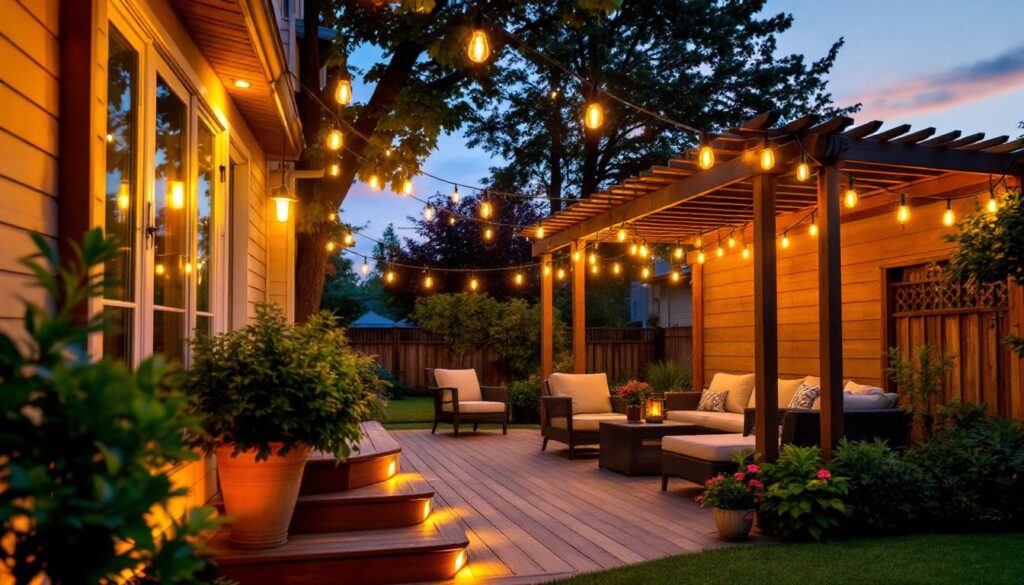
String lights and bistro systems deliver ambiance for entertaining spaces. Unlike cheap plastic alternatives, Dazuma’s versions use marine-grade string and reinforced sockets that won’t degrade after one season of rain. Actual string span typically runs 20–50 feet depending on the model.
Recessed and in-ground fixtures suit landscaping accents. These are buried flush with soil or decking and direct light upward to graze trees, stone features, or plant beds. They require careful placement during installation because moving them later is tedious.
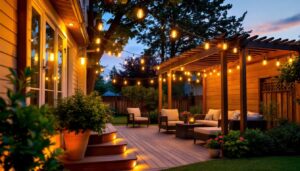
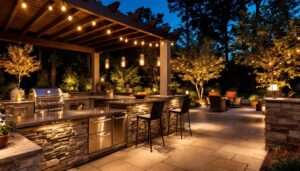
Designers often combine two or three of these types. For example, overhead sconces provide the baseline light, string lights add warmth and definition, and a few in-ground fixtures wash a tree or focal point. This layering is what separates professional-looking outdoor lighting from the “lit like a parking lot” effect.
Installation Tips for Homeowners
Electrical work is the critical part. If your outdoor circuits don’t exist yet, you’ll need to run 12 or 10 AWG wire (depending on amperage and distance) from your main panel to a dedicated outdoor breaker, usually in a GFCI-protected circuit. This is not a handyman job, it requires a licensed electrician in most jurisdictions, and building permits apply. Local electrical codes (NEC Article 680 for wet locations) specify burial depth, conduit type, and breaker requirements.
For existing circuits, test them first with a multimeter to confirm correct voltage (120V standard), grounding, and no open grounds. A qualified electrician can usually verify this in under an hour.
Mounting is simpler. Wall sconces require a stud or robust backing behind the siding. Drill pilot holes, use corrosion-resistant fasteners (stainless or hot-dipped galvanized), and ensure the outlet box is rated for outdoor use and sealed with caulk rated for exterior expansion. Concrete mounting requires concrete anchors suitable for your fixture weight: a 2-pound sconce needs different anchors than a 10-pound chandelier-style pendant.
For post-mount and deck fixtures, pre-drill all holes to prevent wood splitting, especially on composite decking. Use stainless steel bolts and washers to prevent rust staining that bleeds into the surface.
Pathway and in-ground lights demand precise digging. Mark your layout with spray paint or string, then dig holes slightly wider than the fixture base so you can adjust angle and height. Backfill with soil, tamp gently, and check alignment before finishing.
Always turn off the breaker at the panel before handling any wiring, use a voltage tester to confirm power is off, and wear safety glasses when drilling or working overhead.
Design and Decor Integration
Outdoor lighting shapes how people perceive your home’s character. Warm tones (2700K–3000K) near seating and entry areas create comfort: they pair naturally with wood tones, stone, and classic architecture. Cooler tones (4000K–5000K) suit modern minimalist designs and work zones like kitchen patios or workshop areas.
Color temperature also affects perceived space. Warm light feels more intimate and smaller: cool light feels airy and expansive. If your patio is cramped, slightly cooler fixtures can make it feel larger.
Fixture style matters for visual continuity. If your home has farmhouse character, industrial-style Dazuma fixtures with exposed filament or Edison-style bulbs look deliberate. Mediterranean or Tuscan homes benefit from wrought-iron or lantern-style fixtures. Mid-century modern spaces call for clean lines, often with frosted or minimalist shades.
Scape lighting, highlighting trees, stone walls, or fence lines, adds depth and prevents the yard from looking like a black void. When done right, it’s subtle: you notice the effect (a beautifully lit oak tree) rather than the light source itself.
Resources like Gardenista and Southern Living showcase outdoor lighting in real home contexts, which helps refine your aesthetic direction before committing to purchases. Spending 30 minutes browsing finished projects often clarifies what you actually want versus what trends suggest.
Maintenance and Durability Considerations
Dazuma fixtures are built to last, but they’re not maintenance-free. Dust and debris accumulate on lenses, diffusing light over time. Clean fixtures twice yearly, once before the wet season and once before heavy pollen season in spring. Use a soft cloth and mild soap with water: avoid abrasive scrubbers that cloud polycarbonate lenses.
Caulk and sealant around mounting points degrade after 3–5 years in harsh climates. Inspect annually, especially after heavy rain or freeze-thaw cycles. Recaulk if you see gaps or water streaks. Use 100% silicone or polyurethane caulk rated for exterior use: acrylic alternatives fail quickly outdoors.
Bulb lifespan depends on the type. LED bulbs in Dazuma-compatible fixtures run 15,000–50,000 hours (roughly 10–30 years at typical usage). Check the spec sheet on your specific fixture. Smart-enabled models may need occasional firmware updates via the app: set a calendar reminder to check annually.
Corrosion is the biggest killer of outdoor fixtures. Stainless steel and powder-coated aluminum resist it well, but fasteners can corrode if they’re not marine-grade. If you spot rust bleeding from a bolt or fastener, replace it immediately with stainless steel. Salt spray (coastal areas) accelerates corrosion, so yearly inspections are non-negotiable there.
Wire insulation can deteriorate if exposed to UV or punctured during landscaping work. If you notice cracked insulation, have an electrician replace that section of wire, don’t patch it. Most Dazuma systems are designed for 15–20 years with basic maintenance: neglecting caulk and fasteners can cut that to 5–8 years. The upfront cost of quality materials pays back in fewer headaches and replacements. Guides from Hunker often cover practical upkeep routines that extend the life of outdoor systems.
Conclusion
Dazuma outdoor lighting succeeds because it treats light as a tool for living, not just a utility. By combining durable materials, thoughtful design, and smart-home options, these fixtures adapt to how homeowners actually use their outdoor spaces. The real work is in planning, choosing styles that match your home, running proper electrical circuits, and committing to basic maintenance. Done right, outdoor lighting extends both the season you can enjoy your yard and the pride you take in how it looks after sunset.