Table of Contents
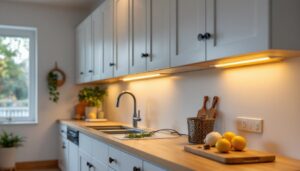
ToggleHardwired under cabinet lighting has become a must-have upgrade for modern kitchens, transforming both function and aesthetics. Unlike plug-in strip lights that clutter your workspace, hardwired under cabinet lighting integrates directly into your home’s electrical system, delivering clean, permanent illumination for countertops and workspaces. Whether you’re renovating your kitchen or simply upgrading outdated fixtures, understanding the best hardwired under cabinet lighting options, from LED strip lights to modular fixtures, will help you make informed choices. This guide covers everything from planning your layout to walking through the installation process, so you can tackle this project with confidence.
Key Takeaways
- Hardwired under cabinet lighting provides permanent, reliable task illumination and polished aesthetics by integrating directly into your home’s electrical system, eliminating the clutter and maintenance of plug-in alternatives.
- LED strip lights work best for continuous cabinet runs with even illumination, while puck lights suit smaller spaces and islands with concentrated lighting needs—both come in dimmable options with color temperatures from 2700K warm to 5000K cool white.
- A licensed electrician must install a dedicated 15-amp circuit from your main panel ($300–$600 labor), making this a non-negotiable safety step that prevents fire hazards and ensures code compliance.
- Proper planning requires measuring cabinet runs, choosing light color temperature (warm 2700K–3000K for traditional kitchens, cool 4000K–5000K for modern spaces), and calculating electrical load before installation begins.
- DIY mounting and wiring of fixtures is achievable for confident homeowners: mount aluminum channels or puck lights with care, secure wires with staples every 16 inches, and test all connections before final adjustments.
- Hardwired under cabinet LED lighting systems typically draw only 0.5–1.5 watts per foot, making them energy-efficient while delivering superior brightness and longevity compared to battery or USB-powered alternatives.
What Is Hardwired Under Cabinet Lighting and Why You Need It
Hardwired under cabinet lighting is a permanent electrical fixture installed beneath kitchen cabinets, connected directly to your home’s circuit. Unlike battery-powered or USB-powered alternatives, hardwired systems don’t require charging or replacement batteries, making them reliable for everyday use.
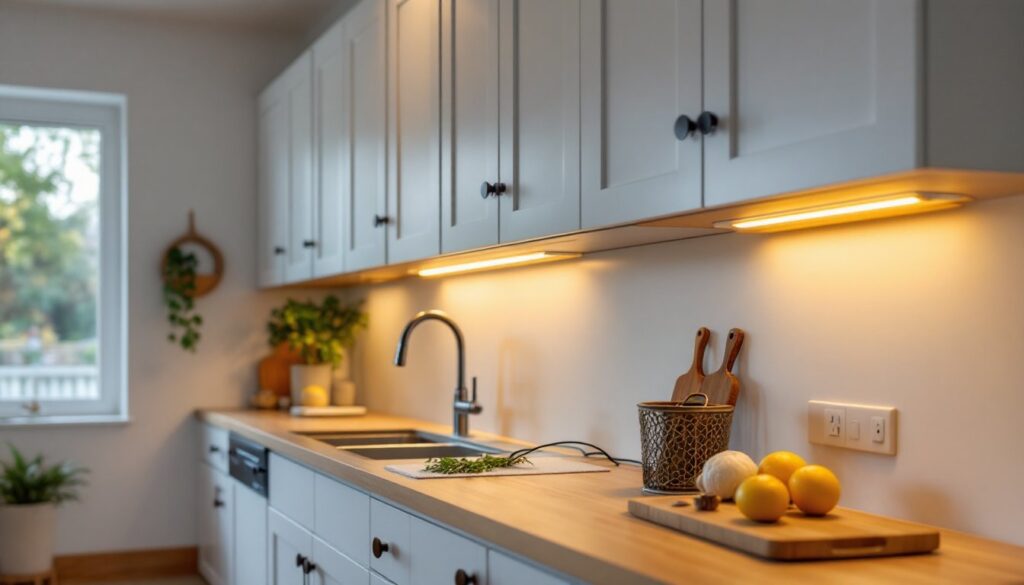
The main benefit is task lighting. Under cabinet fixtures illuminate your countertop workspace, reducing shadows and eye strain when chopping vegetables, reading recipes, or plating meals. They also enhance your kitchen’s ambiance by creating warm accent lighting that reflects off countertops and backsplash.
Hardwired systems offer superior brightness and consistency compared to adhesive-backed LED strips or puck lights sitting loosely under cabinets. Because they’re permanently installed, they look intentional and polished, something that matters when you’re investing in a kitchen upgrade. They also run cooler and last longer than temporary solutions, and many modern hardwired under cabinet led lighting options are dimmable, so you can adjust brightness for cooking or entertaining.
Types of Hardwired Under Cabinet Lighting Systems
Understanding your options helps you choose the best hardwired under cabinet lighting for your layout and budget. Most systems fall into two main categories, each with distinct pros and cons.
LED Strip Lights and Puck Lights
LED strip lights are flexible, continuous strips of LEDs mounted to a thin aluminum channel. They distribute light evenly across long runs of cabinetry and are ideal for kitchens with continuous counter space. Puck lights are individual round fixtures spaced 12–18 inches apart: they’re better for smaller runs or islands where you need concentrated spots of light. Both come in hardwired versions that connect to a dedicated 120-volt circuit.
LED strip lights provide more consistent illumination and work well when hiding the source behind a small trim lip or bezel. Puck lights create a more directional beam and suit kitchens with open shelving or glass-front cabinets where the fixture itself is part of the visual design. Most modern units are dimmable and available in 2700K (warm white) to 5000K (cool white) color temperatures: 3000K is a practical middle ground for kitchen task lighting.
Linear and Modular Fixtures
Linear hardwired under cabinet lighting fixtures are solid bars with integrated drivers and diffusers, designed to replace an entire cabinet run in one unit. They’re more expensive than strip lights but look sleeker and often include built-in dimming controls. Modular systems let you combine multiple fixtures, connected end-to-end, to cover irregular cabinet layouts. Some modular units offer plug-and-play connectivity, reducing the need for splicing wires during installation.
Linear fixtures are excellent if you’re doing a full kitchen renovation and want a designer look. Modular systems work well for phased projects, install over one cabinet row now, expand later. Both hardwired under cabinet led lighting options require a qualified electrician to tie into your main panel, but the long-term durability and aesthetic payoff justify the cost.
Planning Your Installation: Layout and Design Considerations
Before you pick up a screwdriver or call an electrician, map out your project on paper. Measure your cabinet runs in feet, noting any corners, seams, or areas where you’ll need to dodge plumbing or appliances. Most under cabinet fixtures hang 2–3 inches below the cabinet front, positioned to cast light onto the countertop without creating glare in your eyes when standing at the sink or cooktop.
Decide on light color temperature early. Warm white (2700K–3000K) flatters skin tone and works well in transitional or traditional kitchens. Cool white (4000K–5000K) feels brighter and suits modern or contemporary spaces. Mixed-temperature setups, warm for ambient, cool for task, are trending, but that adds wiring complexity and cost.
Calculate your electrical load. Most under cabinet lighting draws 0.5–1.5 watts per foot for LED strips, or 10–20 watts per puck light. A typical kitchen with 20 feet of strip lights uses roughly 10–30 watts total, modest, but still requires its own 15-amp circuit if you’re adding to an existing kitchen. Check your panel capacity and local electrical code (NEC Article 210 covers branch circuits and load calculations). Hire a licensed electrician for circuit installation: this isn’t DIY territory.
Plan your access point for wiring. Most hardwired under cabinet lighting connects through a junction box hidden inside a nearby cabinet, a pantry, or (less ideally) through a soffit. Avoid routing wires across open countertops or through visible cabinet interiors. If your kitchen has a soffit above the cabinets, routing up and through is common: otherwise, you’ll run wire inside the wall cavity or inside the cabinet frame itself.
Step-by-Step Installation Process for DIY Homeowners
Step 1: Have the Circuit Installed
This is non-negotiable. A licensed electrician must run a new dedicated 15-amp circuit from your panel to a junction box near your cabinets. Running undersized wire, daisy-chaining to an existing outlet, or bypassing the panel invites fire hazards. Budget $300–$600 for labor. Once the electrician leaves, you’ll have a 14/2 or 12/2 wire terminated in a junction box with a blank cover plate, ready for you to connect your fixtures.
Step 2: Measure and Plan Fixture Placement
Use a pencil and tape measure to mark the centerline on the underside of each cabinet run. Measure from corner to corner to account for your specific layout. Mark puck light locations 12–18 inches apart, or plan where your strip light sections will start and stop. Use a level to ensure your marks are perfectly horizontal: even a slight tilt makes shadows obvious during use.
Step 3: Mount the Fixtures
For hardwired under cabinet led lighting strips, remove the adhesive backing and press the aluminum channel firmly to the cabinet bottom, starting from one end. Hold it tight for 30 seconds so the adhesive sets. If your cabinets have a soft finish (veneer, paint), rough the surface lightly with 120-grit sandpaper first, clean off dust with a damp cloth and let dry. For puck lights, drill pilot holes where marked, then screw or toggle-bolt them in place (toggle bolts work on hollow cabinets: drywall anchors don’t grip well).
Wear safety glasses during drilling and mounting. If you’re drilling into plywood or MDF cabinet bottoms, use a 1/4-inch bit at low speed to avoid tearout.
Step 4: Run and Connect Wiring
This is where careful routing matters. Feed your fixture wires (usually a thin 18-gauge pair) from the junction box to the first fixture location. Many wired under cabinet lighting systems include a connector or terminal block: push the fixture wires into the appropriate slots and tighten the screws (don’t overtighten, you’ll damage the wire). If your kit includes multiple fixtures on one wire, follow the manufacturer’s daisy-chain diagram exactly.
Secure loose wires with cable staples every 16 inches. Avoid stapling directly over the wire sheathing: staple into the sheathing-free areas or use adhesive-backed wire clips (non-conductive) on painted surfaces. Keep wires away from cabinet hinges, drawer slides, and sharp edges.
Step 5: Connect to the Junction Box
Remove the junction box cover and follow the electrician’s wire labeling (usually black for hot, white for neutral, bare copper for ground). Your fixture wire connects to the existing house circuit inside the box. If you’re uncomfortable with this step, ask the electrician to finish the connection before leaving. Otherwise, use wire nuts to connect like colors (black to black, white to white), push them fully into the box, and secure with the cover plate.
Step 6: Test and Adjust
Flip the breaker on and test your lights. All fixtures should illuminate at full brightness. If they flicker or don’t turn on, check that wires are seated fully in connectors and that the circuit breaker hasn’t tripped. Check for uneven brightness across long runs, this usually means poor contact in a connector: reseat the wire and try again.
Once everything works, configure any smart controls or dimmers according to the manufacturer’s manual. Most hardwired under cabinet lighting led hardwire systems can be retrofitted with wireless dimmer switches for about $50–$150 extra.
If you’re tackling a large installation or uncomfortable working inside a junction box, frame-by-frame guides on DIY project tutorials or home renovation tutorials can walk you through the finer points. For a more hands-on approach, home repair and improvement guides offer step-by-step photo series that break down each stage.
Conclusion
Hardwired under cabinet lighting transforms your kitchen with permanent, reliable task illumination and polished aesthetics. By understanding fixture types, planning your layout carefully, and hiring a licensed electrician for the circuit work, you’ll end up with a professional-quality installation that’ll outlast any temporary solution. Start with honest assessment of your skill level, the electrical work requires a pro, but mounting and wiring fixtures is doable for confident DIYers. Your kitchen counters will thank you.