Table of Contents
ToggleLow voltage LED outdoor lighting has become the go-to choice for homeowners who want to add curb appeal without running expensive new circuits. Unlike traditional 120V landscape lighting, low voltage systems operate on 12V or 24V, making them safer, simpler to install, and far more energy-efficient. Whether you’re lighting a pathway, highlighting trees, or creating ambient evening ambiance, LED low voltage fixtures deliver reliable performance at a fraction of the operational cost. Most DIYers can handle the installation in an afternoon using basic tools, and the payoff, both aesthetically and financially, is immediate.
Key Takeaways
- Low voltage LED outdoor lighting operates at 12V or 24V, making it safer, easier to install, and requiring no electrician or permits compared to traditional 120V landscape systems.
- LED bulbs consume roughly 80% less power than incandescent alternatives, with typical low voltage systems drawing only 50–150 watts total versus 500+ watts for traditional halogen lighting.
- Most DIYers can complete a low voltage LED outdoor lighting installation in one afternoon using basic tools, cable, a transformer, and fixtures—no trenching permits or inspections required.
- Design your low voltage system using layered lighting: path lights for function and safety, accent lights for visual drama on trees or architectural features, and softer ambient fixtures for seating areas.
- Choose fixtures rated IP65 or higher with stainless steel or powder-coated aluminum bodies to ensure durability against rain and winter weather.
Why Low Voltage LED Lighting Is Perfect For Your Outdoor Space
Low voltage LED systems operate at 12V or 24V, compared to standard household 120V circuits. This difference matters. Because they run at lower voltages, they’re inherently safer, no risk of serious shock if you hit a buried cable with a shovel, and no need for a licensed electrician to install them in most jurisdictions. You can run the wiring yourself and bury it a few inches below the soil surface without the heavy conduit and permits that 120V circuits demand.
Energy efficiency is another huge win. LED bulbs use roughly 80% less power than incandescent bulbs, and because the transformer steps voltage down anyway, you’re already operating efficiently. A typical low voltage LED landscape system draws 50–150 watts total, compared to 500+ watts for traditional halogen landscape lighting. Over a season, that’s a real difference on your electric bill.
Installation speed is the third advantage. Most homeowners can transform a yard with low voltage lighting in just one afternoon. No trenching permits, no electrician callbacks, no waiting for inspections. You lay out the path for buried cable, connect fixtures, plug in the transformer, and you’re done.
Types Of Low Voltage LED Fixtures For Different Areas
Low voltage LED fixtures come in several styles, each designed for specific purposes. Spotlights and uplights throw focused beams to highlight trees, architectural details, or focal points: they typically use 3–5W LED bulbs and project light 10–20 feet. Well lights are flush-mounted, ground-level fixtures that graze light across adjacent surfaces or upward into plantings. Wall-mounted sconces attach to home exteriors, decks, or pergolas for ambient light near seating or entryways.
Choose fixtures rated IP65 or higher for outdoor use: this rating guarantees they’ll survive rain, splashing, and winter weather. Stainless steel or powder-coated aluminum bodies resist rust better than plain metal.
Path And Accent Lighting Options
Path lights are the workhorses of low voltage design. They’re typically 12–18 inches tall with a small frosted or clear lens, casting light downward to illuminate walkways and driveways. Most draw 0.5–1W and run for 50+ hours per charge if solar, or indefinitely when hardwired. Space them 4–6 feet apart along paths for even coverage.
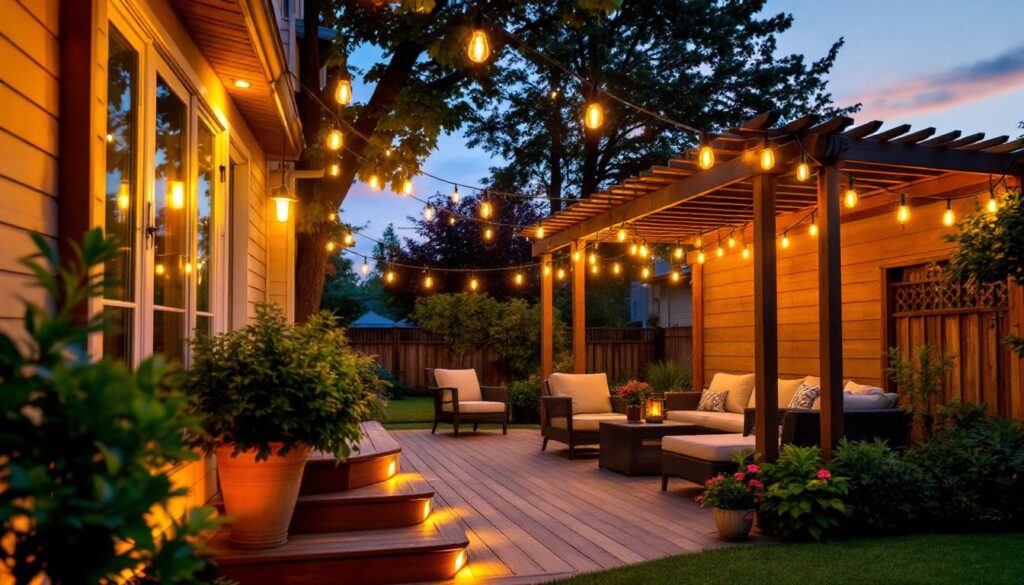
String lights and deck lights work well for patios and entertaining areas. Options include low voltage rope lights (drawing only 1–2W per 10 feet) or small puck lights mounted under deck railings. These are especially popular because they’re flexible and don’t require trenching.
For inspiration and comparison of top-performing systems, recent reviews from Tom’s Guide on outdoor smart lights showcase many low voltage LED options that bridge traditional and smart home approaches.
Essential Components You’ll Need To Install
Every low voltage LED outdoor system needs the same core pieces: a transformer, cable, and fixtures.
The transformer is your power source. It plugs into a standard 120V household outlet (GFCI-protected, ideally), reduces voltage to 12V or 24V, and supplies current to all the fixtures on the circuit. Most home-use transformers are rated 150W–300W: this determines how many fixtures you can run. Calculate your total fixture wattage and choose a transformer that’s 25% larger than that number, a 60W system needs at least a 75W transformer.
Low voltage cable is typically 12/2 or 12/3 gauge, stranded copper, and rated for outdoor use. It’s much thinner and cheaper to buy than 120V cable, and easier to bury and reroute if you change your mind. A 100-foot spool costs $15–$30.
Fixtures vary, but basic path lights cost $8–$20 each, and spotlights run $15–$40. Avoid the cheapest options: they often fail within a season. Look for fixtures with replaceable LED bulbs or modules: proprietary cartridges can become unavailable.
Additional hardware: wire connectors (rated for outdoor use), a shallow trenching tool or flat spade, and if you’re burying cable, marking paint or flags to track the line. You’ll also want a multimeter to test continuity and voltage if something isn’t working.
Step-By-Step Installation Guide For DIY Success
1. Plan your layout. Sketch your yard to scale on paper. Mark existing structures, plantings, and the transformer location. Path lights along walkways? Spotlights for upward drama on trees? Deck lights for evening entertaining? Identify your circuit path, the transformer will serve as the hub, and all cable radiates from there. Check that your transformer’s cord reaches an outdoor outlet (or install one: this is a separate project if you don’t have one nearby).
2. Calculate wattage and choose a transformer. Add up the wattage of every fixture you plan to install. Most path lights are 0.5–1W: spotlights are 3–5W. If your total is 40W, buy at least a 50W transformer. Oversizing is cheap insurance against dimming if you expand later.
3. Lay out the cable. Using marking paint or garden flags, trace the path where cable will run. Avoid areas where you might dig in the future (flower beds, vegetable gardens). Bury cable 6 inches deep in high-traffic areas: 3–4 inches is fine elsewhere. For shallow installations, consider cable covers or protective sleeves where it crosses driveways.
4. Connect fixtures to cable. Most low voltage fixtures use push connectors or screw terminals. Strip about ½ inch of insulation from each wire end, insert into the connector, and tighten. Double-check polarity: positive to positive, negative to negative. Test with a multimeter if you’re uncertain.
5. Plug in and test. Connect the transformer to a GFCI outlet and turn it on. Walk around with a flashlight to confirm every fixture lights. If one doesn’t, disconnect it, check the connection, and retest. A blown fuse in the transformer is rare but possible: check the manual if the whole system fails.
6. Bury cable. Once everything works, use a flat spade to cut a narrow slit in the soil, lay cable inside, and press soil back into place. Cable doesn’t need conduit underground unless you expect future digging. Bury it deeper in beds where you might eventually plant shrubs.
PPE reminder: Wear safety glasses if using a power drill or trenching tool, and work gloves to avoid cuts while handling cable and connectors.
Design Tips For Maximum Visual Impact And Safety
Lighting design is about balance. Too bright, and a yard feels glaring and institutional. Too dim, and safety suffers.
Layer your lighting. Use path lights for function (safe footing), accent lights for drama (uplighting a specimen tree), and softer ambient fixtures near seating areas. This tiered approach gives the eye somewhere to rest and makes the space feel intentional, not randomly lit.
Avoid overlapping shadows. Position spotlights so they don’t cast shadows across walkways where people are walking. An uplight 6 feet from a tree will create strong shadows if someone walks between the light and the tree: move it farther out or use a wider-beam fixture.
Cooler color temperature for safety, warmer for ambiance. 3000K (warm white) LED bulbs feel residential and relaxing near patios. 4000K–5000K (cool white) offers better visibility for pathways and security lighting. Modern low voltage LED bulbs come in both: choose based on the zone.
Dimming and scheduling. Many low voltage transformers now include a timer or smart controller, letting you set fixtures to come on at dusk and turn off at midnight. This saves energy and prevents light spill into neighbor’s yards. If smart home appeals to you, the latest smart outdoor lighting options often include low voltage components.
Don’t light everything. Restraint makes designs stronger. Fewer, well-placed fixtures outperform a scatter of dim lights. A single uplighting a tree or textured facade is more striking than randomly placed path lights.
Check local codes. Most low voltage systems don’t require permits, but some municipalities have rules about outdoor light spillage or operating hours, especially near residential boundaries. Call your local building department if you’re unsure.
Conclusion
Low voltage LED outdoor lighting brings professional curb appeal and genuine nighttime functionality within reach of any homeowner. The combination of safety, efficiency, ease of installation, and relatively low cost makes it one of the smartest home upgrades you can tackle yourself. Start small with a few path lights and a couple of spotlights, see how the design feels over a few weeks, and expand from there. Unlike hardwired lighting, low voltage systems are forgiving, you can move, add, or remove fixtures without rewiring or calling an electrician. Your yard will look better, feel safer, and cost less to illuminate.