Table of Contents
ToggleA well-lit patio transforms how you use your outdoor space, and it doesn’t take a licensed electrician to pull it off. Whether you’re planning summer dinners, creating a cozy retreat, or adding curb appeal, patio lighting installation is one of the most rewarding DIY projects a homeowner can tackle. The right setup balances function and ambiance while keeping safety and code compliance front and center. This guide walks you through choosing the right lighting type, gathering your tools, and executing the installation with confidence. By the end, you’ll understand exactly what separates a pro-looking patio from one that falls short.
Key Takeaways
- Patio lighting installation transforms outdoor spaces while extending living seasons and increasing home value, with budget-friendly options ranging from $100 to $800 for DIYers.
- String lights offer the easiest entry point for patio lighting installation, requiring only outdoor outlets and basic mounting hardware, while low-voltage deck lighting provides safer and more practical illumination without line-voltage electrical work.
- Proper cable drainage and water management are critical—run lines at 5–10 degree angles and avoid horizontal runs to prevent water pooling in sockets, which compromises even weatherproof components.
- Low-voltage systems are DIY-friendly and handle 10–20 fixtures per transformer, but any line-voltage recessed ceiling work requires a licensed electrician and building permits to ensure fire safety and code compliance.
- Always test voltage at the transformer and each fixture location before finishing, use only outdoor-rated components, and avoid overloading circuits by confirming your outlet has dedicated circuits not shared with kitchen or bathroom circuits.
- Plan maintenance upfront by choosing LED bulbs (25,000+ hours) over incandescent (1,000–2,000 hours), and inspect cable connections annually to catch corrosion before it becomes a hazard.
Why Patio Lighting Matters for Your Home
Good patio lighting does more than let you see after sunset. It extends your outdoor living season, improves security by illuminating dark corners, and dramatically increases your home’s value and curb appeal. Potential buyers notice a well-lit patio, it signals that you’ve invested in the space.
From a practical standpoint, layered lighting (ambient, task, and accent) makes a patio genuinely usable. Ambient lighting sets the overall mood: task lighting lets you grill or read safely: accent lighting highlights landscaping or architectural features. Without intentional lighting design, your patio becomes a dark void after dusk, and you’ll stick to indoor entertaining.
Budget-wise, patio lighting ranges from under $100 for basic string lights to several thousand for professional low-voltage systems. Most DIYers can achieve excellent results in the $200–$800 range, depending on the size of the space and whether you’re hiring a professional for the trickier electrical work.
Types of Patio Lighting to Consider
Your choice depends on your budget, patio layout, and desired aesthetic. Below are the most popular options for homeowners.
String Lights and Bistro Setups
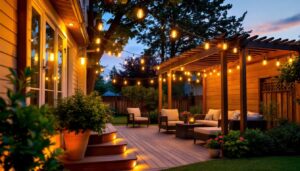
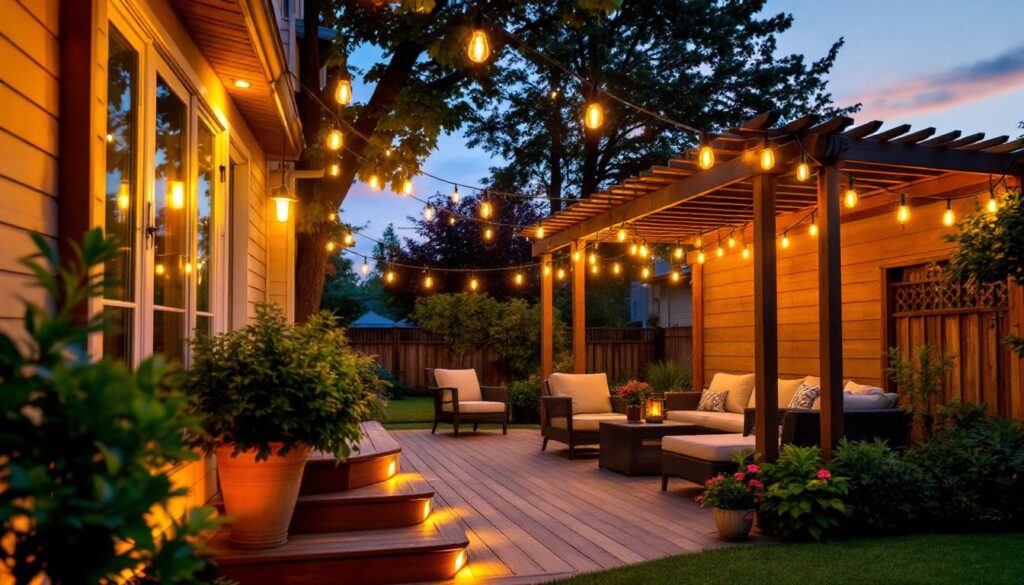
String lights are the easiest entry point for patio lighting. They’re affordable, require minimal electrical knowledge, and create instant ambiance. Cafe-style string lights (also called bistro or Edison lights) use vintage-looking bulbs and cable, strung between posts, walls, or overhead structures. They work great for smaller patios and need only an outdoor outlet and some mounting hardware.
The catch? They’re more decorative than functional. You won’t grill safely under them, and a few burned-out bulbs can leave dark gaps. Install them low enough (7–8 feet is typical) so they don’t catch rain water in the sockets. Use weatherproof socket covers and outdoor-rated extension cords if you can’t reach a permanent outdoor outlet directly. String lights pull about 40–100 watts depending on bulb count, so a standard 20-amp outlet handles them fine.
Recessed and Deck Lighting Options
Recessed lights and low-voltage deck lights look sleeker and provide more practical illumination. Recessed patio lights (usually 4–6 inch trim rings) mount flush into soffits or patio ceilings and cast downward light without glare. They require running electrical cable through your soffit, which means either existing runs or some demolition.
Deck lighting includes step lights (LED units mounted on riser boards), under-rail lights, and post-cap lights. These are low-voltage systems (12V) powered by a transformer, making them much safer and easier to install than line-voltage (120V) circuits. You run low-voltage cable along your deck frame, no conduit required, and mount fixtures where you need them. The trade-off: low-voltage lights are dimmer and pricier upfront, but they’re ideal for safety on stairs and edges. Low-voltage transformers typically handle 10–20 fixtures on a single circuit, so plan accordingly.
Essential Tools and Materials You’ll Need
For String Lights:
• Outdoor-rated extension cord or direct outlet access
• Hooks, eye bolts, or lag bolts (for secure mounting)
• Weatherproof socket covers
• Replacement bulbs (keep spares)
• Cable clips or zip ties
For Recessed/Deck Lighting:
• Low-voltage transformer (12V, 60–100W typical)
• Low-voltage outdoor cable (UL-rated, 12/2 gauge common)
• Recessed trim rings, housing, and bulbs (or deck fixtures)
• Wire connectors (outdoor-rated, push-in preferred)
• Voltage tester (essential safety tool)
• Mounting hardware: brackets, screws, conduit clamps
General Tools:
• Cordless drill/driver
• Tape measure and level
• Voltage tester or multimeter
• Wire stripper (for low-voltage work)
• Flashlight and headlamp
• Ladder or step stool
• Eye protection, work gloves, and hearing protection
Before you buy anything, determine your power source. Can you reach an existing outdoor outlet, or will you need to run new circuits? Line-voltage work (120V) for recessed lights usually requires a licensed electrician in most jurisdictions, check local building codes. Low-voltage systems are DIY-friendly, but confirm your local code allows it.
Step-by-Step Installation Instructions
String Light Installation (Easiest Path):
- Plan your layout. Sketch where you’ll mount fixtures, overhead beams, posts, walls, or hanging cables. Mark mounting points with painter’s tape.
- Install brackets. Use eye bolts or lag bolts with washers (3/8-inch diameter standard). Drill pilot holes into wood: use anchors for masonry.
- Run cable. Attach the main cable from point to point, leaving a slight sag (1–2 inches per 10 feet) so water doesn’t pool in socket areas. Secure with cable clips every 2 feet.
- Mount sockets and bulbs. Insert weatherproof socket covers before mounting. Use outdoor-rated LED or incandescent bulbs: LEDs last longer and run cooler.
- Test before finishing. Plug in your extension cord and verify all lights work before fastening cable permanently.
Low-Voltage Deck Lighting:
- Mount the transformer. Install a 12V transformer near your power source (usually an existing outlet on the deck or under the eaves). Ensure it’s covered from rain and mounted at least 12 inches above grade.
- Run cable. Lay low-voltage cable along deck joists or under railings, clipping it every 3 feet. Unlike line-voltage, this doesn’t require conduit, but keep it away from sharp edges and high-traffic areas.
- Install fixtures. Connect fixtures using push-in wire connectors or solder (solder is overkill for DIY: push-in is fine). Strip ¼ inch of insulation from cable ends.
- Test with a multimeter. Before burying any cable, measure voltage at each fixture point to confirm 10–12V. A significant drop means undersized cable or too many lights on one run.
- Secure and finish. Use cable clips to hold everything in place. Cover connections with silicone sealant if exposed to weather.
For any line-voltage work (recessed ceiling lights, hardwired circuits), stop and hire a licensed electrician. Building permits and inspections exist because sloppy electrical work causes fires.
Common Mistakes to Avoid
Underestimating prep work. Homeowners often rush into mounting without measuring or checking for obstacles (plumbing, HVAC ducts, existing wiring). Spend an extra 30 minutes mapping your patio overhead, it saves frustration later.
Ignoring water drainage. String light sockets must sit with the cable angling downward so rain runs off, not into the socket. Even “weatherproof” sockets fail if water pools. Avoid horizontal runs: aim for a 5–10 degree angle.
Mixing voltage standards. Low-voltage and line-voltage in the same space is fine, but don’t try to daisy-chain transformers or repurpose 120V fixtures for low-voltage runs. It won’t work and it’s a fire hazard.
Skipping voltage testing. If you’re running low-voltage cable, test at the transformer and at each fixture location. A cheap multimeter ($15–$30) catches problems before they become nightmares. DIY project tutorials often detail voltage testing in electrical sections.
Using indoor-rated components outdoors. Outdoor wire, connectors, and sockets aren’t optional, they’re rated for UV, moisture, and temperature swings. Indoor-rated wire degrades rapidly in sun and humidity.
Overloading circuits. A standard 15-amp outlet can handle about 1,800 watts. Most string light setups pull 100–400 watts, so you’re fine. For multiple lighting zones, confirm your outlet has dedicated circuits and isn’t sharing with kitchen or bath circuits. Many patios have undersized outdoor circuits: a licensed electrician can confirm yours.
Forgetting about maintenance. LEDs last 25,000+ hours: incandescent bulbs 1,000–2,000 hours. Plan for replacement, especially on recessed fixtures (awkward to swap). Also, cable connections degrade over time, so inspect every spring and re-seal any corroded connectors.