Table of Contents
ToggleOutdoor tree lighting transforms your landscape after dark, adding drama, depth, and functional beauty to your yard. Whether you’re enhancing curb appeal, creating an inviting patio space, or highlighting a specimen tree, the right lighting approach makes all the difference. From classic uplighting to modern smart systems, there are dozens of ways to illuminate trees without overwhelming your landscape or driving up your electric bill. This guide covers seven practical outdoor tree lighting ideas you can carry out yourself, each with specific product recommendations and installation tips.
Key Takeaways
- Uplighting positioned 3–5 feet from the tree trunk at a 45-degree angle creates dramatic, even illumination without harsh spotting or wasted light into the sky.
- String lights work best on open-canopy trees like dogwoods and crabapples; use warm white 2700K LEDs and hang them 8–10 feet high with secure anchor points to prevent sagging.
- Outdoor tree lighting ideas range from budget-friendly solar options ($40–80) to smart hardwired systems that integrate with home automation and voice assistants for full yard control.
- Spotlights (15–25 degree beam angle) positioned 10–15 feet away highlight specific tree features like twisted bark or flowering canopies, but one or two highlights per tree prevents over-lighting.
- Ground-level recessed fixtures on 12-volt circuits provide safe, subtle ambient lighting while remaining nearly invisible during the day and protecting wiring 6 inches deep in mulch beds.
- Color-changing RGB lights offer seasonal flexibility, but restraint in use—one or two accent fixtures per tree—keeps displays elegant rather than gimmicky for residential landscapes.
Uplighting for Drama and Depth
Uplighting is the workhorse of landscape lighting. Position fixtures at ground level pointing upward to silhouette the tree’s canopy and trunk against the night sky. This technique creates a moody, high-impact effect that draws the eye without looking harsh.
For uplighting, you’ll want LED uplights rated for outdoor use, typically 10–30 watts depending on tree size. Brass or black aluminum housings hold up best to weather: avoid plastic fixtures that degrade in UV sunlight. Mount fixtures 3–5 feet away from the trunk, angled so light hits the lower canopy without pointing directly into the yard where it’ll create glare.
Common mistakes: burying the light too close (you’ll see a hot spot instead of an even glow) or angling it too high (light wastes into the sky). Aim for a 45-degree angle for most deciduous trees. For deeper canopy trees like oaks or maples, test a 35-degree angle first. Professional landscape uplighting techniques demonstrate how to layer multiple uplights for larger specimens.
String Lights and Canopy Effects
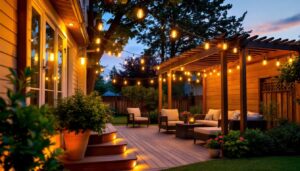
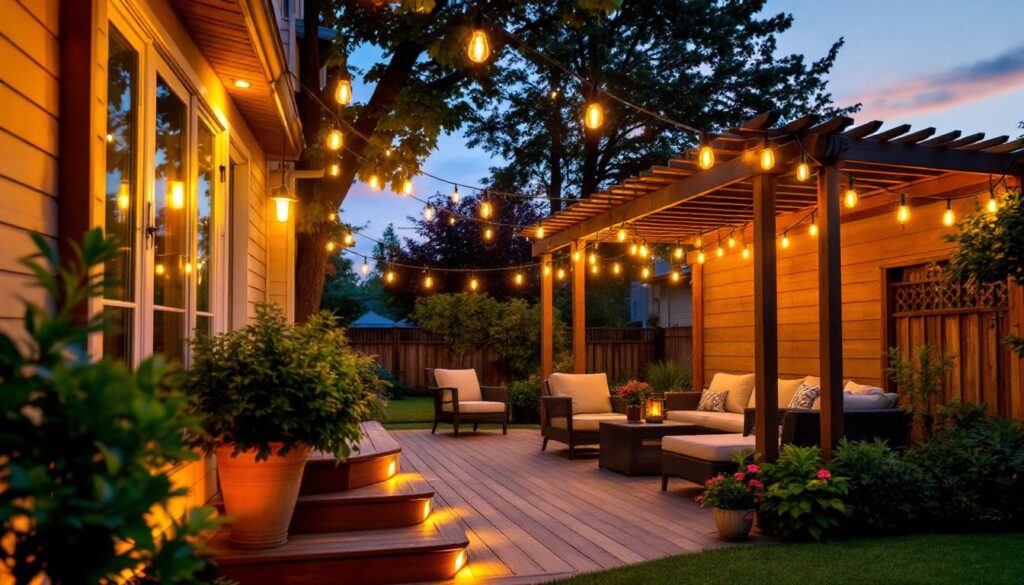
String lights draped through tree branches create a festive, intimate glow perfect for patios and entertaining spaces. This approach works best with open or semi-open canopies, dogwood, crabapple, or smaller ornamental trees, where light can filter through without getting lost.
Choose weatherproof string lights rated for outdoor use, typically 35–50 watts total per strand. Warm white (2700K) LEDs feel cozier than cool white: this color temperature is measured in Kelvin and is a standard way to describe light warmth. Hang strings in a loose swooping pattern 8–10 feet above ground, anchoring ends to nearby poles or house eaves.
Installation: strings need solid anchor points, so don’t rely on weak branches. Use adjustable guy-line tensioners to prevent sagging as branches move in wind. For larger trees, you may need 2–3 strands crisscrossed for even coverage. Design inspiration and practical outdoor decorating tips showcase how various regions approach patio and tree lighting. Keep strands away from sprinkler zones and power lines.
Spotlighting Tree Features
Spotlights narrow the beam to highlight specific features: a twisted trunk, architectural branching, or a flowering canopy. Think of spotlights as a spotlight on a theater stage, high intensity, focused direction.
Use narrow-beam LED spotlights (15–25 degree beam angle) rated for outdoor mounting. These fixtures work best on stands or mounted to nearby structures, not buried in soil. Position 10–15 feet away from the tree at a slight upward angle to avoid washing out texture and detail.
Spotlighting shines on specimen trees with interesting bark, unusual shape, or seasonal blooms. A crape myrtle’s peeling bark looks stunning under spotlight: so does an old twisted apple tree. Avoid over-spotlighting, one or two highlights per tree is usually enough. For smaller accent trees in beds, spotlights mounted on stakes work well.
Ground-Level and Base Lighting
Ground-level fixtures at the tree’s base create a soft wash that emphasizes shape without drama. This subtle approach works in formal gardens or where you want ambient light without strong shadows.
Install recessed ground lights around the base perimeter, spaced 2–3 feet apart. Most are 5–10 watt LEDs rated for foot traffic (heavy-duty lens rating). These fixtures sit flush with soil or mulch and are nearly invisible during the day. Wire them on a 12-volt circuit with a buried low-voltage transformer for safety, 12-volt systems are shock-proof and require no permit, unlike 120-volt outdoor circuits.
For lawn areas, make sure fixtures are in mulch beds or hardscaping, not directly in turf where mowers will hit them. If the tree base is in a planter or bed, run wiring along the bed edge and bury it 6 inches deep to protect from damage. Home improvement resources and DIY lighting guides provide detailed low-voltage wiring layouts.
Smart and Solar-Powered Options
Smart tree lights connect to WiFi or Bluetooth, letting you control brightness, on/off schedules, and sometimes color from your phone. Solar-powered versions skip the wiring entirely, they charge by day and light at night.
Solar uplights (10–20 watts equivalent) work best in full-sun locations. They’re cheaper upfront and require no electrician, but battery life degrades in 2–3 years, and output drops on cloudy days. Expect to pay $40–80 per fixture: hardwired options cost $30–60 but need installation. Smart LED systems integrate with home automation: you can schedule trees to turn on at sunset or dim during late-night hours to minimize light pollution.
A hybrid approach works well: solar string lights for accent areas, hardwired uplights for primary focal points. Smart systems shine when you have multiple trees, one app manages the whole yard’s lighting schedule. Most require 2.4GHz WiFi and work with voice assistants like Alexa or Google Home. Warranty and app support vary: buy from established outdoor lighting brands with consistent reviews.
Seasonal and Color-Changing Displays
Color-changing RGB lights let you adapt tree lighting to seasons or special occasions. Red and green for winter holidays, soft amber for autumn, cool blue for summer entertaining.
RGB LED fixtures offer millions of color combinations, usually controlled via remote or app. Plan for 2–3 color-capable uplights per tree: they’re pricier than standard LEDs ($80–150 per fixture) but offer flexibility. For seasonal displays, stick to 2–3 colors per season, constant color-cycling looks gimmicky in a residential yard.
Realistic approach: most homeowners use one or two RGB fixtures as accents, not for every tree. A single color-changing uplight on a specimen tree lets you shift mood with the season. Spring pastels, summer whites, autumn golds, winter cool-tones. Holiday sequences (twinkling, fading, chase patterns) work best on string lights, not uplights. Balance novelty with restraint: your neighbors will appreciate it.
Conclusion
Outdoor tree lighting combines function, beauty, and manageable DIY installation. Start with one or two trees, choose an approach that fits your space and budget, and expand gradually. Layer different techniques, uplighting for drama, string lights for ambiance, spotlighting for detail, and you’ll create a landscape that shines by day and captivates after dark.